
"Lonely Together," my review of Loneliness: Human Nature and the Need for Social Connection by John T. Cacioppo and William Patrick (W. W. Norton) and Loneliness as a Way of Life by Thomas Dumm (Harvard University Press), appears in the 31 October 2008 books section of The National (Abu Dhabi, U.A.E.).
Month: October 2008
The campaign in posters
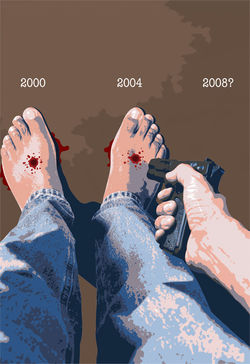
Having missed by about an hour a chance to buy Shepard Fairey's newest Obama poster, I fell down the Google rabbit hole and stumbled into an entire unsuspected world of Obama poster art. The definitive blog seems to be the Obama Art Report, with daily news of auctions, donations, and free downloads. If, however, you'd prefer a Continental synopsis of the scene, a French-writing blogger named Jeremie has culled what he considers the fifty best Obama posters at Visual Evasion, complete with click-through links to the designers, who, in the case of, say, The Match Factory, are still selling the posters and sending the proceeds to the Obama campaign (in their case, to the Nebraska Obama campaign). It was by clicking on one of Visual Evasion's links that I discovered that from now until the election, you can download a poster a day at 30 Reasons, whose number one reason was the very funny poster at left by Chaz Maviyane-Davies.

If you'd prefer to make your own poster, using specially designed pro-Obama letters, try visiting Spelling Change, where you can also make T-shirts and bumper stickers.
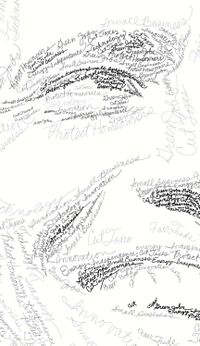
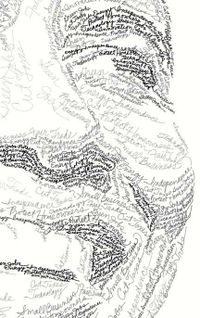
Alternately, you can make a poster by downloading and printing out someone else's. If you download all the pieces of Larry Roibal's poster, which at the molecular level consists of his ballpoint-pen cursive transcription of phrases from Obama's policy proposals, assemble them, and photograph yourself next to them, he'll post the picture on his blog.
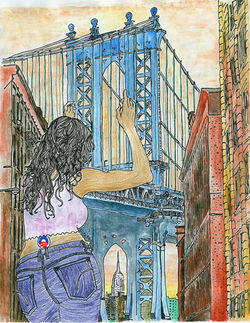
Some charming posters were commissioned by the Obama campaign for their voter-registration and voter-protection project, Vote for Change. Artist Cody Hudson has posted a few, and you can find a couple of others scattered in the open-to-all-comers site Design for Obama, which has the good, the bad, and the unofficial, all of which can be voted on. I was kind of taken with the Newyorkiness (Loisadaness?) of art teacher Robt Seda-Schreiber's Baby Got Hope, below. And last but not least, there are still a few all-typography posters for sale on the Obama-Biden campaign's own website, in the purchase of which you kill two birds with one click.
Catching Up #3
- For Undercurrent, A. S. Hamrah praises the film criticism of Manny Farber, who was also a painter:
Asked whether his painting and his criticism had things in common, he answered, "The brutal fact is that they're exactly the same thing." He did not accept the idea there was a difference between artists and critics. ("I get a laugh from artists who ridicule critics as parasites or artists manqués—such a horrible joke.") In fact, his prose equals the subjects he wrote about and often surpasses them. While this may be true of some film critics writing today, saying their prose equals the subjects they write about is not a compliment.
- Who's finer: the Temptations or the Four Tops? At Moistworks, Sean Howe answers by imagining the romance and disappointment of a couple named Bill and Liz:
Tonight, he puts on "Ain't Too Proud To Beg" and starts singing along, and before long is thinking about the ridiculousness of the idea that begging Liz would do any good at all. As if life was anything like a Motown song. And at the part where Ruffin sings about a crying man being "half a man, with no sense of pride," Bill can't sing along anymore. Ruffin is hitting way too many high notes to be nearly as upset as he claims, and Bill begins to get furious at the record. It feels like some kind of cruel facsimile of pain. The way the other four Temptations buoy Ruffin at every turn, he's not alone, not by a long shot; his buddies have his back, and he's still dancing. Bill thinks that maybe The Big Chill had it right, and that "Ain't Too Proud To Beg" is simply a way to make doing the dishes more enjoyable. He tries not to think about how he is now older than the Kevin Kline and Glenn Close characters.
- For the London Review of Books, Mark Greif parses the disingenuous chic of the television series Mad Men (subscription required):
Beneath the Now We Know Better is a whiff of Doesn’t That Look Good. The drinking, the cigarettes, the opportunity to slap your children! The actresses are beautiful, the Brilliantine in the men’s hair catches the light, and everyone and everything is photographed as if in stills for a fashion spread. The show’s ‘1950s’ is a strange period that seems to stretch from the end of World War Two to 1960, the year the action begins. The less you think about the plot the more you are free to luxuriate in the low sofas and Eames chairs, the gunmetal desks and geometric ceiling tiles and shiny IBM typewriters. Not to mention the lush costuming: party dresses, skinny brown ties, angora cardigans, vivid blue suits and ruffled peignoirs, captured in the pure dark hues and wide lighting ranges that Technicolor never committed to film.
Sooner or later, though, unless you watch the whole series with the sound off, you will have to face up to the story.
- In an essay commissioned for my boyfriend Peter Terzian's forthcoming anthology Heavy Rotation: Twenty Writers on the Albums that Changed Their Lives and pre-printed in the November 2008 Harper's, John Jeremiah Sullivan remembers calling up legendary blues savant John Fahey for help in deciphering lyrics:
A front-desk attendant agreed to put a call through to Fahey's room. From subsequent reading, I gather that at this time Fahey was making the weekly rent by scavenging and reselling rare classical-music LPs, for which he must have developed an extraordinary eye, the profit margins being almost imperceptible. I pictured him prone on the bed, gray-bearded and possibly naked, his overabundant corpus spread out like something that only got up to eat: that’s how interviewers discovered him, in the few profiles I’d read. He was hampered at this point by decades of addiction and the bad heart that would kill him two years later, but even before all that he’d been famously cranky, so it was strange to find him ramblingly familiar from the moment he picked up the phone. A friend of his to whom I later described this conversation said, "Of course he was nice—you didn’t want to talk about him."
Fahey asked for fifteen minutes to get his "beatbox" hooked up and locate the tape with the song on it. I called him back at the appointed time.
"Man," he said, "I can't tell what she’s saying there. It's definitely not 'boutonniere.'"
"No guesses?"
"Nah."
We switched to another mystery word, a couple of verses on: Wiley sings, "My mother told me, just before she died/Lord, [precious?] daughter, don’t you be so wild."
"Shit, I don’t have any fucking idea," Fahey said. "It doesn't really matter, anyway. They always just said any old shit.
Implausibility
Has Milan Kundera been wrongly accused? On 18 October 2008, the New York Times published a second article about the recent discovery of a 1950 police memo that suggests that the Czech novelist may have given information to the police that led to the arrest and 14-year imprisonment of Miroslav Dvořáček, a Czech who was working undercover for a Western intelligence agency. The new Times article, by Dan Bilefsky, describes a further wrinkle in the case:
The mystery became even murkier this week when Zdeněk Pešat, a literary historian and former member of the Communist Party, told the Czech news agency CTK that Mr. Dlask had told him years before that he had reported Mr. Dvořáček to the secret police, most likely because he wanted to prevent his girlfriend from being punished.
As is noted in both the Times article and the original report in Respekt by Adam Hradilek that revealed the existence of the police memo, Miroslav Dlask is not a new character in the drama. He was a close friend of Kundera’s at the time that Dvořáček was betrayed, when the two were in film school together. I related the somewhat byzantine story in an earlier post, but here’s a recapitulation: While on an undercover mission in Prague in 1950, Dvořáček by chance ran into a childhood friend named Iva Militká, whose ex-boyfriend Miroslav Juppa was working undercover with Dvořáček. Dvořáček asked Militká to hold onto a suitcase and promised to come by her dorm and pick it up later that day. Naively, Militká told her then-boyfriend Dlask about the mysterious visitor and asked him to stay away that evening, explaining that Dvořáček would probably want to spend the night. Someone seems to have passed the information along to the authorities. When Dvořáček showed up to claim his suitcase, the police were waiting for him.
Militká told Respekt that she had nightmares about Dvořáček for years afterward, and Respekt reports that Dvořáček himself seems to have believed her guilty of turning him in up until the time of a stroke he suffered earlier this year, which apparently has rendered him incapable of communicating. Dlask and Militká went on to marry, and according to Militká, Dlask admitted to her that he told Kundera about Dvořáček but refused to say more (Dlask died in the 1990s). And it is Milan Kundera’s name that appears on the recently discovered 1950 police report as the informant. The memo is careful to specify that Kundera was bringing third-hand information:
Today at 4pm, there arrived at this police station the student Milan K u n d e r a , born 1 April 1929 in Brno, residing in Prague district 8 in the student dormitory on King Jiří VI St., and he gave the information that in this dormitory there lives a student Iva M i l i t k á , who communicated to the student Dlask, of the same dormitory, that on this day she met in the Klárov neighborhood of Prague with a certain acquaintance Miroslav Dvořáček. The latter, it is said, gave her the custody of 1 briefcase, saying that he would come for it in the course of the afternoon of 14 March 1950. On the basis of this declaration, constable Rosický together with constable Hanton went to the place in question, where they conducted an inspection of the briefcase . . .
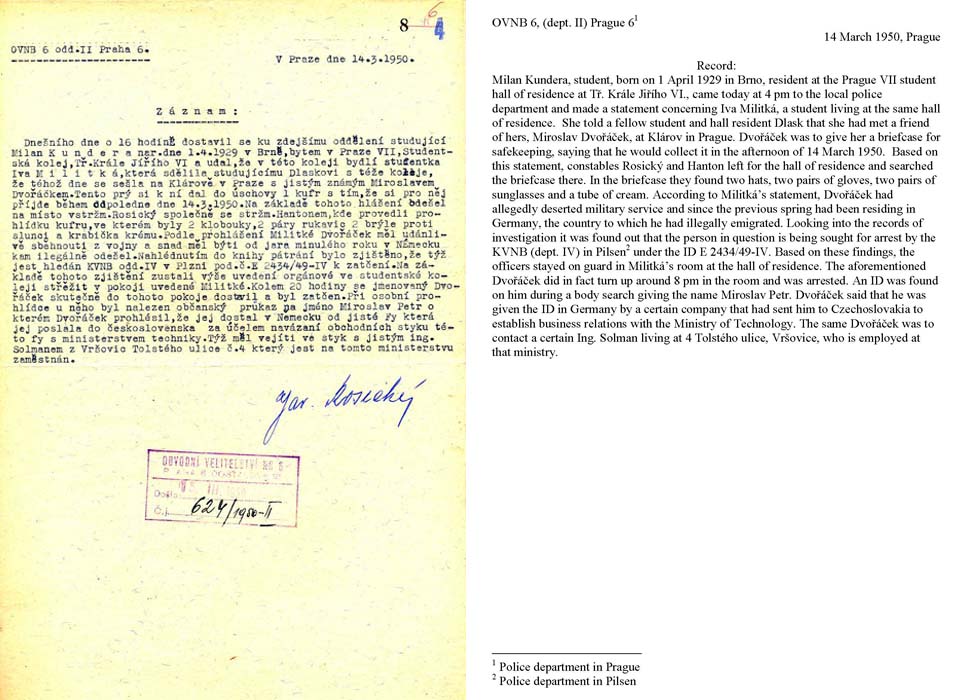
Fans and friends of Kundera have naturally wished to find a way to explain the memo away. In the Czech press, almost no one has tried to argue that the memo is a forgery. As Petr Třešňák writes, “To forge a half-century-old police typescript with the appropriate diction, stamps, and knowledge of the context of the case is a feat few could pull off.” Zdeněk Pešat’s new testimony opens another possibility: Maybe it was Dlask who informed on Dvořáček, and Kundera’s name appears on the police memo in error. Or maybe Dlask informed on Dvořáček while impersonating Kundera.
Here, for the record, is a translation of the public statement that Pešat released to the Czech press:
When I read in Tuesday’s Lidové noviny about the developments in the “informer” scandal surrounding Milan Kundera and saw the name Miroslav Dlask and a photograph of Iva Militká, an incident from the spring of 1950 came to mind.
At that time I was in the third year of the Philosophical Faculty of Charles University in Prague and a member of the school’s Communist Party council. Miroslav Dlask turned to me with the communication that his girlfriend (and future wife) Iva had met with a former comrade, whom she knew to have fled to the West and to have returned apparently illegally. Dlask told me that he had notified security. He felt that he had to inform his local party organization about it. And because we had studied aesthetics together and since he knew me better than any other member of the school Communist Party council, he told me. I assumed that Dlask wanted to protect his girlfriend from the possibility, which could have become a reality, that it was disclosed that she had had contact with an emigrant or even perhaps an agent provocateur from State Security forces. To this communication I in no way reacted, and I spoke of it with no one.
I did not meet with Dlask after college and I put it out of my mind. I am a seriously and incurably ill person, in essence a bedridden patient dependent on a respirator. For this reason I am incapable of meeting with anyone and must refuse any interview. Yesterday, after reading the newspaper, I told my wife about the incident with Dlask. We agreed that I would write out everything I knew about these things, and that’s what I have done.
Asked about Pešat’s statement, the editors of Respekt insist that they stand by their story. Of course, it’s possible that Kundera told the local police department about Dvořáček, and that Dlask told their school’s party official about him. It’s easy to reconcile Pešat’s memory with the police memo by imagining that Dlask told Pešat something along the lines of “We took care of this,” meaning that he and Kundera did, and that Pešat either didn’t hear Kundera’s name or forgot about it later. And Pešat’s statement doesn’t help at all in explaining how Kundera’s name showed up in police records. Indeed, when asked to explain it by the Czech news service CTK the next day (in an interview conducted despite his illness), Pešat merely said that he had received a phone call from Kundera that morning and that Kundera was fighting the allegation and rejected it.
Hradilek and others have raised the possibility that Dlask was jealous of Dvořáček, and turned him in (or arranged to have him turned in) to remove a romantic rival. This possibility, too, fails to exonerate Kundera, unless one also supposes that Dlask impersonated Kundera at the police station. But if Dlask wanted his nose clean so badly that he was willing to impersonate Kundera to the police, then why did he tell Pešat in person? And if Dlask wanted his nose clean, isn’t the likelier explanation that he asked his friend Kundera to take the story to the police for him?
Another line of exoneration is the hypothesis that Kundera did turn Dvořáček in, but that he thought Dvořáček was merely a “suspicious person,” and had no idea he might be an undercover agent. “Kundera as the foreman of his dormitory was responsible,” writes Lidové noviny, explaining a theory put forward by Jiří Pernes of the Institute for Contemporary History. “If Dlask informed him of a foreigner in the dormitory, then he notified the police. At that time, it probably didn’t even occur to him that because of this, Dvořáček could receive years in prison. It was for him an episode, and so it’s possible he doesn’t even remember it.” It’s an ingenious explanation but not in my opinion a persuasive one. In the police memo, Kundera, or an informer going by his name, relays Militká’s statement that Dvořáček “had allegedly run off from the army and perhaps had been living in Germany, where he had immigrated illegally.” Whoever turned Dvořáček in knew that Dvořáček was going to be in big trouble.
A number of Czech commenters have complained that Hradilek oughtn’t to have published his article until he found corroborating documents. But what if there’s only one document, and it’s this one? It may be that this is all the evidence historians will get.
Catching Up #2
- Liz Brown reviews a new biography of Emily Post for the Los Angeles Times: “Claridge tracks Emily’s rise from vivacious debutante to poised but neglected society wife and mother against the backdrop of the Gilded Age, deftly tucking in such capsule anecdotes as the déclassé Vanderbilts vying for high-society acceptance and instructions for preparing terrapin, which includes a directive one isn’t likely to forget: ‘Remove the skin from the feet.’ “
- Interviewed about his forthcoming book How to Live, Henry Alford admits to thinking, as he accompanied his mother to buy a Chiquita banana costume, “I bet Joan Didion doesn’t do this kind of research.” Bonus: On his new blog, Henry deconstructs Louise Bourgeois’s love of spirals.
- At Slate, Christine Kenneally reviews Henry Hitchings’s history of English (which I reviewed not long ago for the now-defunct New York Sun) along with books on English by John McWhorter, Mark Abley, David Crystal, Roy Blount Jr., and Ammon Shea: “It’s hard to resist the urge to pick a particular kind of animal as the perfect emblem for English. McWhorter says it’s a dolphin among deer. He calls German, Dutch, Yiddish, Danish, and other close English relatives antelopes, springbok, and kudu. English has evolved so far away from the basic language body plan, he says, that it swims underwater and echolocates.”